Showing posts with label magnet. Show all posts

Thursday, December 27, 2018

The advantages and disadvantages of using a Halbach array with a BLDC (PMSM) motor

In the last post it was shown that the length of the rotor magnets has an impact on the specific torque density of an electric motor. Longer magnets will, in general, produce a larger flux density at the poles but this comes at the expense of a larger flux gap. Therefore, the optimum magnet length for our motor model was around 2-4 mm.

However, there is an alternative arrangement of magnets in the rotor that, according to many a forum post all over the internet, will significantly increase the torque density of any motor.

The Halbach array

Credit: Wikipedia
If you are not familiar with the concept of a Halbach array then its wiki page has all the relevant information. In this post we will be testing the impact of adding a simple Halbach array to our model motor in FEMM.

Four different scenarios for a simple motor model

While more details regarding this motor can be found in this post a brief description is as follows: It is a 6 slot, 8 pole motor with three phases wound as concentrated windings in a pattern of ABCABC. All current in the windings is on the q-axis and in this case there is a 4.5 mm flux gap with 4 mm long magnets. FEMM simulation results shown below.


Back iron only
Torque output: 0.714 N.m 


Back iron and Halbach
Torque output: 0.714 N.m 


Halbach Only
Torque output: 0.683 N.m 


Neither back iron or Halbach
Torque output: 0.435 N.m 

It's clear that adding a Halbach style arrangement of magnets to the rotor has no impact on the torque produced when back iron is also used. However, it makes a considerable difference when the rotor back iron is removed, giving roughly 50% more torque than the non-Halbach arrangement. 

A simplified example

The reason for this is clear when you look at a simplified arrangement of magnets.
Back iron only

Back iron and Halbach

Halbach Only

Neither back iron or Halbach

The back iron produces a high magnetic permeability path for the permanent magnet 'flux' to pass through. The use of a Halbach array eliminates the need for back iron and so the use of both a Halbach array and back iron will only increase the cost and weight of a motor, with no improvement in performance.

If we draw a downwards line from the surface of the exposed magnets in the images above and plot the flux density at each point we see the following.


It is clear that the flux density is the same with or without the Halbach configuration provided that back iron is used. Therefore, a Halbach array does not act to redirect the flux from one side of a magnet, concentrating it on the other, as is sometimes stated. Therefore, it only makes sense to use a Halbach array when designing a motor which has no 'back iron' in the rotor. However, having no back iron in the rotor is essentially the same as having an infinite flux gap. As was shown in the last post, the highest torque density was achieved for our model motor when the flux gap was kept small using thin magnets. So not only would a Halbach configuration for this motor be considerably more expensive to manufacture, it would also have a lower torque density.

There are of course exceptions to this example. Completely core-less electric motors (no stator or rotor iron) such as this example often use Halbach arrays as a means to increase their otherwise terrible torque density. The benefit to this design is that the lack of iron core losses means that these motors can be quite efficient provided eddy currents in the windings and magnets is adequately controlled. They also produce no cogging torque. As far as I can tell, core-less motors are also popular among hobbyist because they eliminate the need to cut your own Fe-Si steel lamination. If you are looking to make a one off custom motor as a hobbyist my advice would be to re-use an off the shelf stator (either new or from a donor motor) and modify it to your own needs. This approach will always give you a higher torque density than a core-less motor and will often be cheaper since you don't need to purchase as many, or as large, expensive magnets or litz wire for the windings. 

Understanding BLDC (PMSM) electric motor constants - Optimal magnet length for high torque density

In the last post it was shown that the torque density of a motor can be improved by making the flux gap as small as possible. It was also seen that the rotor magnets are considered part of the flux gap. Therefore, it would appear that an ideal motor will always have rotor magnets that are as thin as possible.

However, it is also well known that the longer you make a permanent magnet, the larger the flux density at its surface. This raises an important question: Are long magnets and a large flux gap better than short magnets and a small flux gap when it comes to producing the most torque?
Small flux gap and magnets on the left, large magnets and flux gap on the right.

The short answer: 

For a 'hobby grade' out-runner electric motor the optimal magnet length will depend on your exact motor design, but in general, it will likely be around 1 to 4mm in length. Shorter magnets see a rapid fall off in their flux contribution to the airgap while longer magnets increase the magnetic reluctance of the magnetic circuit, reducing the stator contribution. Very long magnets will also cause the stator and rotor back iron to saturate which reduces performance.

Read on if you would like a more detailed understanding.

Permanent magnet self demagnetisation

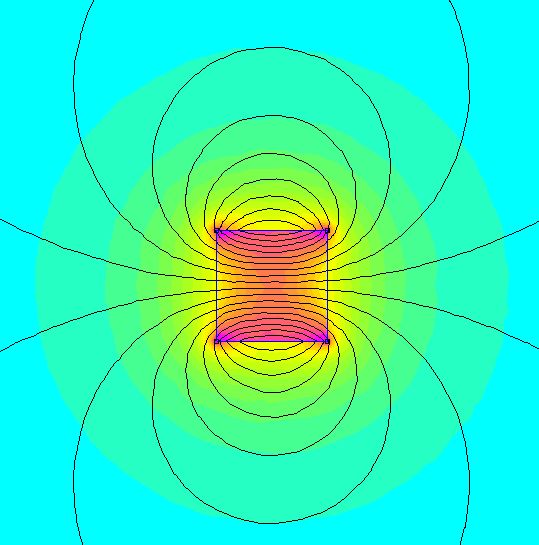
Below are four magnets  modelled in FEMM with a length of 1, 2, 4 and 8 mm 


Despite each magnet being made of the same material there is a clear difference in the flux density present at the surface poles. The reason for this effect is that shorter magnets have a higher demagnetisation factor in that direction. The demagnetisation factor reduces the B field inside the magnet and is dependent upon the magnet geometry. The concept of a demagnetisation factor also applies to soft magnetic materials, not just permanent magnets. Long magnets will have a lower demagnetisation factor than shorter magnets. Unfortunately, there is no simple equation that can be used to describe the demagnetisation factor for something as basic as a cube. However, there is a simple relationship for an ellipsoid. Note that if you have a magnetic circuit that makes a closed circuit then the demagnetisation factor is zero but there are also no magnetic poles.

If we draw a line projecting out from the surface pole of each magnet and measure the flux density at each point we get the following plot.


Here we can see that the flux density in air for the 8 x 8 mm magnet at a distance of ~ 10 mm is the same as the surface (0 mm distance) for the 1 x 8 mm. This trend of increasing flux density with magnet length does not continue forever. The flux density in air at a distance of 0.5 mm from the surface of the magnets is plotted vs magnet length below.


As the magnet is made longer, and its demagnetisation factor in that direction decreases, the field produced at the surface poles would eventually approach that of the magnets remanent magnetisation. The plot above will look quite different if the same magnet was instead placed into the rotor of a motor since you then also have high magnetic permeability material in the stator and rotor helping guide the flux from the magnet, reducing its demagnetisation factor. However the overall concept remains the same.

Effect of magnet length on the torque produced by a simple motor

As in the previous post, we can use a simple model of a motor to test how different magnet lengths impact the torque produced for a fixed winding current. Below are four different scenarios. Each motor has a gap between the stator and the magnets of 0.5 mm. Therefore, the total flux gap is given by the magnet length + 0.5 mm. 

1 mm rotor magnet

2 mm rotor magnet

4 mm rotor magnet

8 mm rotor magnet
We can see a few things right away. First, the flux density in the rotor 'back iron' increases considerably as you make the magnets longer to the point that the back iron begins to saturate. This can also be seen in the stator teeth. Secondly, we can see that more flux escapes the rotor and fringes into the surrounding air. This is due to the saturation of the back iron. 

The flux density in the flux gap is plotted below with different length magnets. The flux contribution from only the stator windings was estimated by removing the magnets and simulating the motor. The same was done for the flux density contribution for the magnets, this time with the stator winding current set to zero.


It is clear that as you make the magnets longer the flux contribution from the stator becomes smaller due to the increase in the flux gap size. On the other hand, the flux density contribution from the magnets increases as they are made longer. Based on this plot we would expect that the torque will continue to rise as the magnets are increased in length. However, when the rotor torque is plotted with respect to the magnet length we can see that maximum torque is reached for magnets that are about 4 mm long. Further increasing the magnet length sees the torque slowly fall off.


This fall off in torque for magnets longer than about 4 mm is likely due to the stator core and rotor back iron beginning to saturate. Perhaps more interestingly is if we plot the specific torque density (torque per unit volume) and gravimetric torque density (torque per unit mass).  

When the magnets are made longer they are adding mass and volume to the entire motor while the torque gradually decreases. Therefore, there is a sharp fall off in the specific torque density for magnets longer than about 2 mm. Note that in the above example only the magnet length was changed. If more than one parameter was refined for, such as the thickness of the back iron, then the results will differ from those above.

In addition to just the torque output there are many other factors which need to be considered when you change the length of the magnets contained in a motor. A few that come to mind may include:
  • Core losses are likely to increase when magnet length is increased as the stator and rotor iron is operating closer to saturation. Stray flux from the magnets may also cause more eddy current losses in the windings.
  • Magnets are easily the most expensive part of a hobby grade electric motor. Therefore, motor cost will increase considerably if you were to use longer magnets, even if a redesigned motor did see a slight increase in torque with magnet length.
  • Increasing the magnet length will add more mass to the rotor which increases its moment of inertia, reducing the dynamic response time of the motor.
  • Cogging torque generated by the salient poles of the stator will likely be much worse with more powerful magnets
  • There are many different grades of magnetic materiel. Using more or less powerful magnets would likely change the optimum magnet length.

Conclusion

Increasing the length of the permanent magnets used in a 'BLDC' (PMSM) motor will increase the torque produced only up to a point. The optimum magnet length will depend on many factors, but as a general rule of thumb, this length will be between 1 and 4 mm for 'hobby grade' out-runner electric motors constructed with back iron in the rotor. Further increasing the magnet length will only reduce the motor performance and increase the motors production costs.

If you have noticed any errors in the above article then please let me know. If you would like to play around with any of the models shown in this post in FEMM you can find the files hosted hereThis tutorial gives you enough information to get started if you have never used FEMM before.